
Flat Orgs Are Not Democracy Thinking

You Must Have a Plan for Power
You can run an organization outside of power dynamics, but only if everyone who participates agrees to the rules.
Those who believe in Power, gaining it and wielding it, know that sometimes you need to amass power quietly and use it strategically. Which is why Democracy 3.0 must have a plan for Power. This does not mean to pursue secret power, but to put in place the checks and balances that embed Power within the System, instead of subordinating the System to Power.
We cannot eliminate Power. I believe it is actually a necessary part of societal and personal evolution. Until you understand it, understand how it affects you, and how to manipulate power, you can never really learn how to escape the Power Game, and so you will always be subject to its rules.
It takes a new set of rules, universally upheld, to establish a new way of operating.
Power = Decisions
Whether by individual decision or by vote, the ability to decide what others must do is the core of power, particularly if those people do not have the choice of whether or not to opt in to those decisions.
Consider any project that is too big for a single person to complete. In classic terms there are personnel decisions, design decisions, planning decisions, implementation decisions, verification decisions, and operational decisions. Someone may understand more than one area, but if they do not have the time to do all the things, they don’t have the information to make the decision. However holds that role – personnel, design, planning, implementation, verification, or operations – does (or should) have the knowledge to make that call. Above a certain project size, someone must have more decision-making authority within their area of expertise than someone else.
I have also never seen an organization where people did not need mentorship to learn how to grow into a new role. Training and the passing down of knowledge implies greater knowledge about an area than someone else. Two people can even be peers, but there will always be an imbalance of knowledge and experience creating a power dynamic.
Democracy 3.0 Has Levels
Hierarchy does show up as Roles vs Jobs at Step 5 in Democracy Thinking, but the 6 Decision Points illustrate how to keep these natural imbalances of power in check. Checks and balances should be everywhere, there must be multiple of them, and they must be universally applied by those who wish to participate in and benefit from the system.
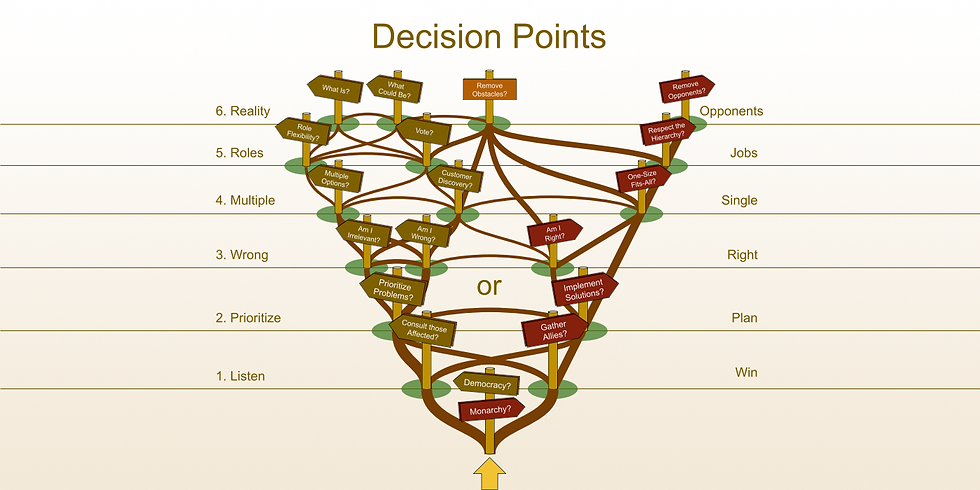
Someone may be an expert in an area, but you should always be able to ask, “Who did you talk to about that?”
If a decision solves a problem for a particular person in a particular role, how does that problem fit into the Prioritized Problems?
What assumptions were made, where might the person be wrong or irrelevant, and what does the data tell us?
Someone may have the power of decisions within their project, but with multiple simultaneous solution experiments, there may be someone else who can provide a contrasting view through their alternative path.
Decisions belong to that person while they are in that role, but role flexibility (instead of permanent jobs) means that someone else gets a chance to weigh in with their experience through the next experiment.
All this opens the door to new ways of collaborative thinking that can rewrite a better future.
Democracy Thinking wants people to step forward, own something, and make decisions. It just also asks them to be able to answer these 6 decision points for their choices in order to receive system approval.
Flat Organizations Are A Myth
The “Flat Hierarchy” concept is about getting rid of middle managers. It’s a response to a real problem, but only when you work within Monarchy Thinking. When you work within Monarchy Thinking, the hierarchy executes the dynamics of power and coercion. The desire to solve that problem is admirable. It’s just that eliminating manager roles doesn’t really solve that problem.
Every “flat hierarchy” I have ever seen personally or heard described by another has retained one remaining power element. The person who instituted the “flat hierarchy” retained final decision authority for themselves, “just in case”. This is still Monarchy Thinking.
Pair that with the fact that we still need a way to resolve disputes. We still need mentors. We still need experts. We still need people to do the research and work necessary to complete a job and bring it to reality. All of these things create temporary imbalances, which again are normal (and healthy).
Two options happen:
The person at the top of the “flat hierarchy” abdicates and does nothing. In the wake of a decision maker, and without a system of checks and balances, natural tendencies for secretly amassing and leveraging power result in unchecked informal hierarchies that can be worse than middle managers.
The person at the top becomes the single, all-powerful decider to resolve disputes. But they can never know the whole story, so their decisions are destined to cause more problems than they solve.
Don't Fear Power | Keep It In Check
This is why my aim is to surface the new techniques and possibilities available to us now through Democracy Thinking that were not possible in the past. We now have the technologies and knowledge to do things different and create a better future where we ALL want to live.
If you want to learn more or hear more about the techniques I’m exploring and collecting for future-thinking organizations, subscribe.


Comments